National Cabinet meets today amid soaring fuel prices and tumbling equity markets, as the reality of a prolonged war in the Middle East starts hitting Main Street Australians. National Cabinet will today focus on fuel security and supply, particularly for regional Australia. But petrol rationing is unlikely, according to media reports. It comes after the Albanese government, over the weekend, said it will underwrite purchases of fuel by private companies. Some states are moving ahead with their own plans to reduce reliance on petrol and diesel. Victorian Premier Jacinta Allan has announced free public transport in the state, from tomorrow.
The housing market is slowing appreciably, with the preliminary clearance rate for auctions over the past week at its lowest level since 2022. Sydney and Brisbane markets are hardest hit.
Almost ten million households spent $83 billion online last year in Australia, a significant increase from a year earlier. The latest Australia Post eCommerce report says the rise in spend was 14 per cent in 2025, and two-in-five household that shop online, do so at least fortnightly.
Coalition frontbencher Andrew Hastie has broken ranks with his colleagues by supporting a major overhaul of the tax system, including possible changes to the capital gains tax discount, negative gearing and a windfall profit tax on gas exporters.
Interest in electric vehicle purchases have almost doubled in recent weeks, with finance inquiries up 88 per cent this month alone.
Wall Street is bearing the brunt of the Middle East war, with the Dow Jones, which measures the top 30 stocks on the bourse, falling into correction territory over the weekend, while the broad-based S&P500 ended its fifth straight down week. That’s the worst losing streak since 2022. The Nasdaq100 is down 11 per cent since it peaked in October.
Fear-o-meter
US President Donald Trump might believe his methods of overseeing a war in the Middle East make sense, and perhaps the US’s goals are being met. The problem is that financial markets are getting to the point where they don’t believe him anymore.
Over the weekend, when the Trump Administration said the war would be over in weeks, not months, Wall Street tumbled. Up until that point, it tended to move up on the good headline and down on the bad headline.
Now investors don’t believe what Trump and his team are saying, and they are dumping equities. Add in the fear that interest rates are about to rise because of inflation pressures, and concerns about AI related companies being over-valued, and investors are selling.
The tech heavy Nasdaq closed down more than two per cent over the weekend, and the index had its worst week in nearly a year.
The Nasdaq100 is down 11 per cent since it peaked in October, and two of the worst performers are two of the biggest AI spenders. Since late October, Microsoft is down 34pc and Meta is off 29pc. Even Nvidia, the Street’s favourite stocks, is off 20pc from its high.
Fear & Greed Q+A today
On the week ahead for the economy, including why there'll be a lot more attention paid to the minutes of last RBA meeting than usual:
“Normally the minutes come out and they pretty much go through to the keeper because we know the RBA governor, Michele Bullock, after each decision, gives a press conference and outlines a whole lot of what was discussed.
So the minutes are usually just a bit of a rubber stamp of that.
However, this time we’ve got that five–four split, and we don’t know exactly why there was that division. Suffice to say, it does appear as though at least four people — and probably all nine to some extent — are worried about the contractionary effects of the oil price shock and the petrol shock we’re seeing at $2.75, $3, even $3.25 a litre.
And goodness, it hurts — it’s an instant hit to household spending and consumer confidence.”
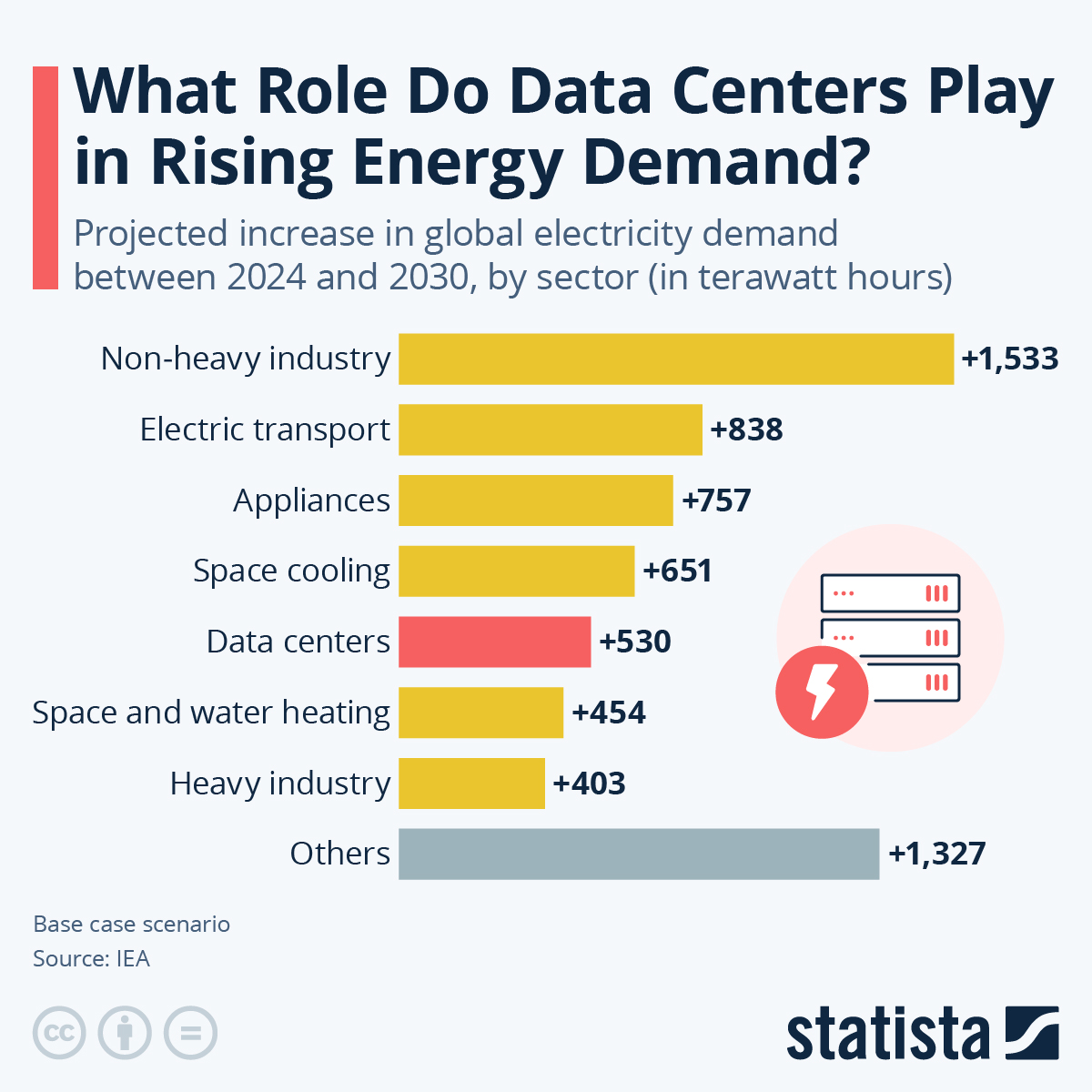
Data centres are major users of electricity, especially as AI use grows and the number of data centres globally increases. But modelling from the International Energy Agency suggests that growing electricity demand from other sectors will actually exceed that of data centres over the next few years. We're looking at you, air con.
Forwarded from a friend? Sign up to our daily newsletter